
Is the B.Ed. Degree Losing Its Shine in Tripura? Trends, Jobs, and Societal Expectations (2010–2025)
CULTURECOMMUNITYINNOVATIONFEATURED
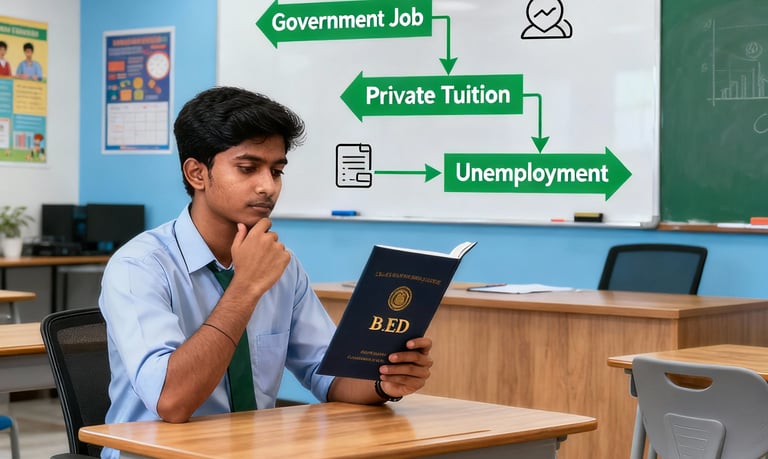
From 2010 to 2025, the B.Ed. degree in Tripura has seen declining public sector relevance, with job growth for graduates lagging behind rising enrollments. Government jobs remain highly coveted, but most B.Ed. holders turn to private tutoring, highlighting a disconnect between academic training, employment realities, and social expectations.
B.Ed. in Tripura: Between Academic Pursuit and Job Market Realities
The Bachelor of Education (B.Ed.) degree, once synonymous with a gateway to stable government jobs in Tripura, is increasingly under scrutiny. Over the last 15 years, shifting job markets, surging private tuition culture, and changing expectations have questioned the degree’s ability to deliver on employment promises. While B.Ed. remains a benchmark for quality teaching, trends from 2010 to 2025 indicate increasing disconnects between higher education and employment opportunities in the state—a story that resonates with global readers interested in education trends from India.
Surging B.Ed. Graduates, Diminishing Opportunities
Between 2010 and 2025, Tripura has seen a notable rise in B.Ed. enrollments and graduates, spurred by a high literacy rate exceeding 87% and growing aspirations for upward mobility. Yet, this rise has not matched government sector absorption. Government teaching jobs, historically considered the summit of achievement in the state, have become scarcer due to retirements outpacing new recruitment and a shrinking number of available posts. For instance, over 10,000 teaching positions were vacated due to retirements in just five years, but only 4,656 new hires were made, leaving nearly 5,700 posts vacant.
Public sector recruitment suffered further setbacks due to controversies such as the annulment of over 10,000 teacher appointments through court verdicts between 2014–2017, when regulatory lapses in the recruitment process were cited. This disruption forced many qualified B.Ed. holders out of secure employment pipelines, fueling both unemployment and emigration of talent.
A Disproportionate Aspiration for Government Jobs
Tripura continues to assign unparalleled value to government service; landing a government job remains the ultimate dream for most youth, offering perceived job security, respectable pay, and social status. Yet, B.Ed. graduates are increasingly finding themselves either unemployed or underemployed, as government jobs are not keeping pace with the output of teacher training institutions. This has led overqualified candidates, including those with master's and B.Ed. degrees, to apply for lower-level or unrelated posts, such as clerical or Group D positions, due to the dearth of teaching vacancies.
Private Jobs and the Rise of Parallel Schooling
In response to an oversupply of B.Ed. holders and a scarcity of government posts, many have turned to the private sector or started tutoring. Private coaching participation in Tripura is among the country’s highest: nearly 79% of school students take private tuition, compared to regional and national figures that are considerably lower. This growing parallel economy has absorbed some of the unemployed, but salaries and job security in private schools and tutoring are significantly less than in the public sector.
For example, the average annual salary for a primary or secondary school teacher in Tripura private institutions ranges from 127,700 INR ($1,530) to just under 465,000 INR ($5,600) depending on experience and role, which is modest compared to the social position expected of B.Ed. graduates. This is leading to a mismatch between qualification and satisfaction, especially when juxtaposed with the state’s still-prevalent idealization of government service.
Educated Unemployment: The Data Speaks
The trend of educated unemployment among degree holders (especially graduates and postgraduates, which includes B.Ed. degree holders) reveals a chronic predicament:
· In 2015–16, there were 162 job seekers with higher education qualifications; this number peaked at 1,188 in 2018–19, before dipping to 645 by 2021–22, reflecting both supply-demand mismatches and shifting registration patterns.
· B.Ed. holders remain among the largest groups of job seekers registering for government employment year after year—with only a small fraction of them absorbed into teaching roles.
· Participation among women and scheduled tribes in job-seeking has notably increased, but unemployment remains higher among these groups, highlighting continued socioeconomic gaps.
Shifting Academic and Social Attitudes
The spike in B.Ed. graduates, diminishing public sector absorption, and a low expansion rate in the organized private sector are creating unusual societal expectations:
· A growing pool of degree holders is chasing shrinking government opportunities, resulting in frustration and often an undervaluing of private sector roles, despite their growing importance in the real economy.
· Many families continue to encourage B.Ed. and similar degrees in the hope of eventual government placement, while newly-minted graduates face tough competition and uncertain returns.
· The cultural preference for government jobs remains so pronounced that even when other professional avenues exist, they are often seen as second-best.
Conclusion: Reimagining B.Ed. and Career Paths in Tripura
While B.Ed. is still vital for pedagogical quality and remains mandatory for formal teaching roles, the degree is losing its old guarantee of government employment in Tripura. The parallel rise in private sector teaching and tutoring underscores both the adaptability and anxiety among Tripura’s youth. Policy recommendations point toward the need for diversified skill development, private investment in education, encouragement for entrepreneurship, and a reframing of aspirations beyond government jobs to bridge education-employment gaps and foster sustainable growth.