
From the North Sea to the Outback: The Universal Science of Fuel
INNOVATIONEDUCATIONCOMMUNITYCOLLEGE NOTES
Ready to master the science behind the energy that powers our world? This overview covers the essentials, but the real engineering lies in the details. To get the in-depth understanding, step-by-step calculations, process diagrams, download the complete note now.
A Fuel's Global Identity: Classification and Analysis
Scientifically, all fuels are categorized by origin and physical state. Primary fuels are extracted directly from nature—think of the vast coal seams of the Hunter Valley in Australia or the rich oil fields of the Permian Basin in the USA. Secondary fuels, like the gasoline from European refineries or coke from British steel mills, are manufactured through chemical processing.
To assess a fuel's quality, we analyze its composition. For a solid fuel like coal, two key methods are universal:
Proximate Analysis: A practical assessment of moisture, ash, volatile matter, and fixed carbon. This is crucial for a power plant operator in Germany deciding how to handle their lignite coal supply.
Ultimate Analysis: A precise elemental breakdown of Carbon, Hydrogen, Sulphur, Nitrogen, and Oxygen. This data is vital for engineers designing advanced, low-emission combustion systems everywhere.
The Heart of Power: Calorific Value
The single most important metric for any fuel is its calorific value—the heat released during combustion. The distinction between Gross Calorific Value (GCV), the theoretical maximum, and Net Calorific Value (NCV), the practical usable energy, is critical. This is especially true when dealing with high-moisture resources like the brown coal found in parts of Europe, where the difference between GCV and NCV significantly impacts power plant efficiency.
The Art of Enhancement: Global Refining and Synthesis
Crude oil, whether it's the benchmark Brent Crude from the UK's North Sea or Urals oil from Russia, is useless in its raw state. Through fractional distillation, this primary fuel is separated into valuable products.
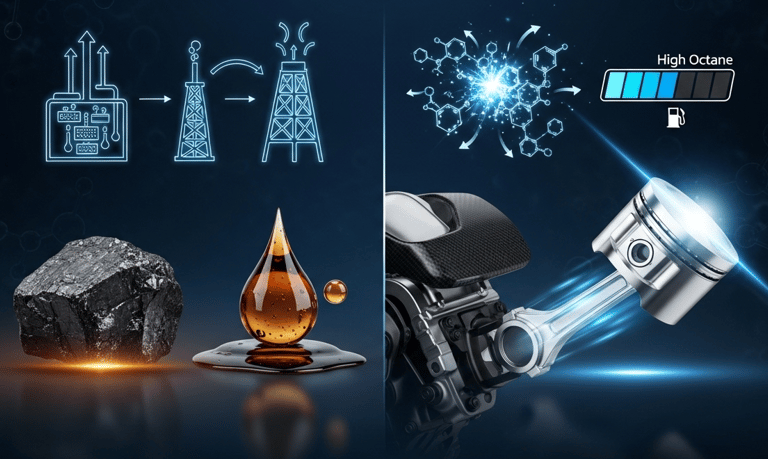
However, simple distillation doesn't produce enough gasoline. The solution is cracking, a process that breaks heavy hydrocarbon molecules into smaller, higher-value ones. While this technology is used worldwide, some regions have taken it a step further. South Africa, for instance, is a world leader in synthetic fuel production. Using the Fischer-Tropsch process, its Sasol plants have perfected the art of converting coal into high-quality liquid fuels—a testament to how chemical engineering can overcome resource limitations.
Performance Under Pressure: A Tale of Two Numbers
The quality of a transport fuel is defined by how it behaves inside an engine.
In the USA, with its history of powerful, large-displacement engines, a high Octane Number is paramount. This rating measures a petrol's ability to resist "knocking," ensuring a smooth and powerful combustion cycle.
In Europe, where high-efficiency diesel engines are far more common, the Cetane Number is the key metric. This rates a fuel’s readiness to auto-ignite under compression. A high cetane number is essential for the quick, clean combustion that European emissions standards demand.
This dichotomy perfectly illustrates the global principle: fuel chemistry must be precisely tailored to its application.
From the historic coalfields of the UK to the massive gas pipelines connecting Russia and Europe, the world's energy landscape is diverse. Yet, the underlying science—of analysis, calorific value, refining, and performance—remains the common language that allows us to harness these resources and power our global community.